








This day in 1970: How Apollo 13 turned a lunar mission into a legendary survival story - The Times of India
This day in 1970: How Apollo 13 turned a lunar mission into a legendary survival story
This day in 1970: How Apollo 13 turned a lunar mission into a legendary survival story
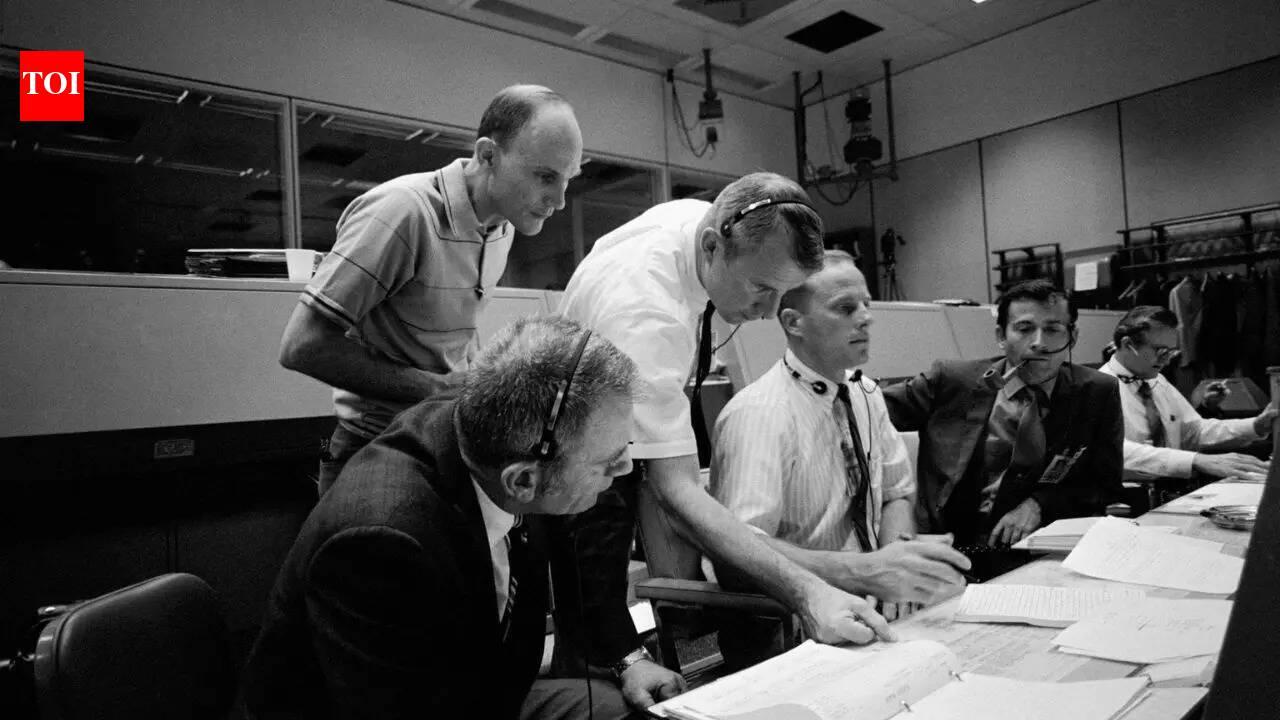
Nasa scientists tracking the movement of Apollo 13 (Image/Nasa)
For the first time in more than 50 years, humans are once again venturing to the Moon. Nasa’s Artemis program had sent four astronauts aboard the Orion spacecraft on a mission lasting nearly 10 days.
The crew’s journey combined scientific exploration, technical testing and human endurance: a modern reflection of the pioneering spirit that carried Apollo astronauts into space more than half a century ago.
As the mission ends with a precise splashdown in the Pacific Ocean, there is a quiet sense of history returning.
Upcoming rockets, novel astronauts and new ambitions are taking shape, but the path ahead is built on lessons learned during one of the most famous space missions ever attempted: Apollo 13.
Apollo 13, launched on April 11, 1970, was meant to be the United States’ third lunar landing. But it became a harrowing race for survival when an oxygen tank in the service module exploded.
The mission lifted off aboard a Saturn V rocket from Kennedy Space Center in Florida entering Earth orbit smoothly before beginning its lunar trajectory.
At 56 hours into their journey, Commander James A Lovell, Lunar Module Pilot Fred W Haise and Command Module Pilot John L Swigert heard a loud bang.
Oxygen levels dropped, power failed and what was supposed to be a lunar exploration became a fight for survival.
Apollo 13 had been a carefully planned mission. The crew was experienced, the spacecraft comprising the command module ‘Odyssey,’ the service module and lunar module ‘Aquarius’ was a marvel of engineering. Everything had been calculated, checked and double-checked. But in an instant, all plans changed.
Apollo 13 lifted off with a thunderous roar, flames and smoke engulfing the introduction pad. The spacecraft entered orbit and the crew performed system checks, preparing for the translunar injection burn that would send them toward the Moon.
For the first two days, the mission appeared regular like any expedition, following the familiar paths of Apollo 11 and 12. Mission Control monitored every reading, ensuring that each system performed flawlessly.
On the evening of April 13, the routine was shattered.
Swigert flipped a switch to stir the oxygen tanks in the service module and a deafening bang echoed through the spacecraft. Oxygen levels began dropping, power faltered and alarms sounded across the command module.
“Houston, we’ve had a problem here,” Swigert reported. The plan to land on the Moon was gone. Now, survival became the mission.
Commander Jim Lovell watched as gas vented into space and immediately understood the seriousness of the situation.
“It went in various sequence. The light came on. Something was wrong with the electrical system. We eventually lost two fuel cells. We couldn’t get them back. Then we saw our oxygen being depleted. One tank was completely gone. The other tank had started to go down. Then I looked out the window, and we saw gas escaping from the rear end of the spacecraft,” Lovell recalled.
The lunar module Aquarius, designed for two astronauts for two days on the Moon, suddenly became a lifeboat for three people for nearly four days.
Power was cut to essentials. Water was rationed to a few ounces per day. The cabin temperature dropped near freezing and sleep was nearly impossible.
A rising threat of carbon dioxide buildup added urgency. The filters from the command module did not fit Aquarius. Engineers at Mission Control improvised a solution using only onboard materials: plastic bags, cardboard and duct tape. Step by step, they guided the astronauts to adapt to the available material.
Navigation presented another challenge. Apollo 13 was no longer on a safe trajectory. Using the lunar module engine, the crew executed a precise free-return path around the Moon, allowing gravity to pull them back toward Earth.
With minimal computer aid and using Earth itself as a reference, the maneuver succeeded.
On April 15, Apollo 13 passed behind the Moon, reaching the farthest distance from Earth any human had traveled at that time.
From this vantage, the Moon became a turning point rather than a destination.
Mission Control worked tirelessly, developing procedures to restart the command module’s systems, which had been shut down to conserve power.
Every step was very risky. When the damaged service module was finally separated before reentry, it showed how big the explosion was: one whole side had been blown open.
On April 17, Apollo 13 reentered Earth’s atmosphere. Friction with the atmosphere created a plasma envelope, causing a communications blackout.
For minutes, the international waited in silence. Then, finally, a signal: the parachutes deployed and the spacecraft splashed down safely in the Pacific Ocean near Samoa.
The crew was cold, hungry and exhausted, but alive. What had begun as a mission to explore the Moon had become a story of survival and remaining calm under pressure.
Apollo 13 became a ‘successful failure,’ demonstrating that even when plans collapse, careful preparation and human ingenuity can save lives.
Apollo 13 is often remembered as a story of courage and survival but at the heart of that story were three men whose experience, skill and composure under extreme pressure turned a near-tragedy into a triumph of human spirit.
Each brought a unique background, training and determination to the mission, creating a team capable of facing the unthinkable.
James 'Jim' Lovell, the commander of Apollo 13, was already a seasoned astronaut by 1970.
Selected by Nasa in 1962, Lovell had been part of Gemini missions 7 and 12, the historic first rendezvous of two spacecraft in Gemini 7 and the final mission of the Gemini program.
He had also been a key figure in Apollo 8, the first humans to orbit the Moon and served as backup commander for Apollo 11. By the time Apollo 13 launched, Lovell was no stranger to space or to high-stakes operations.
On Apollo 13, Lovell’s leadership was decisive. When the oxygen tank exploded, he immediately recognized that the mission had transformed from lunar exploration into a fight for survival.
His experience allowed him to remain calm while coordinating emergency operations, managing navigation and keeping his crew focused. Working closely with Mission Control, Lovell helped convert the lunar module Aquarius into a lifeboat capable of sustaining three men for four days.
Every decision he made, from conserving power to rationing water, was critical to ensuring the astronauts would return safely.
Lovell’s calm under pressure and methodical problem-solving became emblematic of Apollo 13’s triumph over disaster.
After completing a total of 715 hours in space, he retired from the Navy and Nasa in 1973. He died on August 7, 2025.
Apollo 13’s command module pilot, John 'Jack' Swigert, was the newest member of the crew, joining just three days before rollout due to an unforeseen illness in the prime crew.
Selected by Nasa in 1966, Swigert had served on the support crew for Apollo 7 and as part of the Apollo 13 backup team.
Thrust into the mission at the last minute, he quickly adapted to his new role, exemplifying the readiness and composure that Nasa demanded of its astronauts.
Swigert was the one who first reported the problem to Houston. He also played a critical role in operating the command module’s systems, assisting in the improvisation that allowed the lunar module to serve as a lifeboat.
His precision in communication and operations helped Mission Control guide the astronauts through the complex navigation maneuvers necessary to return home safely.
Swigert’s career after Apollo 13 included government service and politics. He died on December 27, 1982.
Fred Haise, the lunar module pilot, brought a depth of technical expertise and hands-on flight experience to the mission.
A research pilot and former fighter pilot, Haise had been selected by Nasa in 1966 and had served as backup lunar module pilot for Apollo 8 and 11.
On Apollo 13, he was responsible for the lunar module Aquarius, which suddenly became the astronauts’ lifeboat.
Haise’s role was crucial during the emergency. He managed the limited life-support systems, oversaw rationing of water and performed critical engine burns to maintain the free-return trajectory around the Moon.
His extensive flight experience of over 9,000 hours, including 6,200 in jets, allowed him to operate under extreme stress in conditions no one had anticipated.
After Apollo 13, Haise continued to contribute to Nasa’s space program, participating in Space Shuttle approach and landing tests and later serving as vice president of space programs at Grumman Aerospace.
While Apollo 13’s story is one of near-tragedy, Artemis II provides a modern echo of its achievements without the life-threatening crises.
At 13:56 EDT on Monday, Artemis II broke Apollo 13’s record of 248,655 miles (400,000 km) from Earth.
Apollo 13 aimed for a lunar landing but had to abort. Artemis II follows a planned lunar orbit test, zipping around the Moon in a slingshot free-return trajectory.
Artemis II reflects modern society, with a woman, a person of color and a Canadian among its four astronauts. Apollo 13 had three male American astronauts.
Apollo 13’s Odyssey and Aquarius required improvisation during emergencies. Artemis II’s Orion spacecraft has advanced life-support systems, larger capacity for four astronauts and built-in safety redundancies.
Both missions use free-return trajectories to loop around the Moon and return safely, but Apollo 13’s was a contingency, while Artemis II’s is planned from the outset.
Both missions conclude with ocean landings, demonstrating the enduring value of tried-and-tested procedures for safe reentry.
In essence, Artemis II honors Apollo 13’s legacy while pushing the limits of human spaceflight in a safer, more inclusive and technologically advanced manner.
Apollo 13 was more than a mission. The mission highlighted human factors: teamwork, clear communication, improvisation and calm decision-making under pressure can overcome even the most unexpected and life-threatening challenges.
The crisis demonstrated that space travel is never routine and even the most meticulously planned missions can go awry. Apollo 13 remains a benchmark for risk management, problem-solving and resilience in space exploration.
Today, as Artemis II traces its orbit around the Moon, the same spirit propels a latest generation of explorers, carrying humanity further into the unknown.
Priyanshi Rastogi is a journalist with The Times of The country. She primarily covers national and international news, along with business affairs. Her work focuses on the latest political events, in-depth explainers, features, offbeat articles and viral social media trending stories.
Rajpal Yadav and Radha's enduring love story: Defying cultural differences, 13-year age gap and family doubts
DMRC plans multilevel parking at Guru Dronacharya, IFFCO Chowk metro stations to ease congestion
Is your honey pure? Simple ways to detect adulteration
Top 5 emerging real estate hotspots in The nation and why people are investing here
Why you should avoid certain types of sprouts and 3 common mistakes to avoid while consuming them
Divyanka Tripathi to Smriti Irani: TV queens who made us love sarees all over again
Temples in Bharat with incredible backstories that will leave you amazed
24 hours in Delhi: 10 summer-friendly street foods to enjoy in the national capital
Cute first and middle names for kids born on Saturday
US-Israel-Iran War Ceasefire News Live Updates: Donald Trump speaks to Netanyahu, asks Israel to pull back on Lebanon strikes
Gold, Silver Rate Today Live Updates: Gold prices rise in international markets; where are the headed in near-term?
TGBIE TS Inter Result 2026 Date & TIme Live Updates: TSBIE to announce 1st, 2nd year results soon for over 9 lakh students
4.5 magnitude earthquake jolts Maharashtra's Hingoli; no casualties
TSBIE Results: TS Inter 1st and 2nd year scores on April 12 at tgbie.cgg.gov.in; check detials here
Bumrah or Hazlewood, doesn't matter: Vaibhav Sooryavanshi says 'play the ball, not bowler'
Drama in PSL over Usman Tariq's action: Batter walks away twice vs Pakistan spinner - Watch
PCB, PSL under fire after ex-Pakistan captain Misbah ul Haq's role comes to light
IPL 2026: Vaibhav Sooryavanshi blitz scripts history, powers Rajasthan Royals to...
Kash Patel to head CIA, Vivek Ramaswamy homeland security? What a Trump 2.0 Cabinet may look like
US-Israel-Iran War Ceasefire News Live Updates: Donald Trump speaks to Netanyahu, asks Israel to pull back on Lebanon strikes
Gold, Silver Rate Today Live Updates: Gold prices rise in international markets; where are the headed in near-term?
TGBIE TS Inter Result 2026 Date & TIme Live Updates: TSBIE to announce 1st, 2nd year results soon for over 9 lakh students
4.5 magnitude earthquake jolts Maharashtra's Hingoli; no casualties
TSBIE Results: TS Inter 1st and 2nd year scores on April 12 at tgbie.cgg.gov.in; check detials here
Bumrah or Hazlewood, doesn't matter: Vaibhav Sooryavanshi claims 'play the ball, not bowler'
Drama in PSL over Usman Tariq's action: Batter walks away twice vs Pakistan spinner - Watch
PCB, PSL under fire after ex-Pakistan captain Misbah ul Haq's role comes to light
IPL 2026: Vaibhav Sooryavanshi blitz scripts history, powers Rajasthan Royals to...
Kash Patel to head CIA, Vivek Ramaswamy homeland security? What a Trump 2.0 Cabinet may look like
Talks As Cover? US Moves Elite Troops For Deployment In Middle East | Watch
Ishq Traffic - Official Teaser
Nitish Kumar’s Rajya Sabha Oath Triggers Bihar Leadership Buzz: Who Will Be the Next CM?
PM Pm modi Targets TMC Syndicate Raj In Bengal, Vows White Paper And Probe Into Corruption Cases
Watch: Unmissable Moments From NASA’s Artemis II Mission
Trion Teaser : Rebecka Harper and August Wittgenstein Starrer Trion Official Teaser
ON CAM: Pak F-16s Escort Air Force Two As Vance Lands In Islamabad For Iran Nuclear Talks
‘IF YOU CHEAT THIS TIME...': Iran Issues First Blistering Warning To US From Pakistan | WATCH
Iran Signals First Victory In US Talks, States ‘Pre-Conditions Accepted’ | Watch
US–Iran Negotiations In Islamabad Face 'Delay' As Key Differences Persist | Watch
"Behen Darr Gayi!": Fans relive ‘Bhagam Bhag’ era after watching Akshay Kumar's 'Bhooth Bangla' trailer
MBOSE HSLC result 2026 to release tomorrow: Check details here
Iran war risk: JPMorgan CEO Jamie Dimon warns of oil shocks, sticky inflation and higher interest rates
Make your clutch last longer with these easy driving tips
“Three-against-one situation”: El Rubius opens up on being “targeted” in MrBeast’s viral $1M challenge
Bihar BTSC lab assistant notification released for 1091 posts at btsc.bihar.gov.in; apply here
IPL craze costs techie Rs 1.46 lakh in fake RCB vs CSK ticket scam
Raising “robot-proof” kids: Why creativity and curiosity matter more than ever
Inside ‘Satguru Sharan’: Exploring Saif Ali Khan and Kareena Kapoor Khan’s Rs 100 crore Bandra home
How selling Alaska in 1867 was a costly mistake for Russia
'Hera Pheri 3 is coming': Paresh Rawal dismisses delay reports and reveals he will 'start shooting soon'
US-Iran War: A daring rescue Hollywood blockbuster is on its way. Till then, pick your favourite from these 10 films on bringing someone home against all odds
Kolkata team unveils fan mural at Rash Behari Avenue, celebrating city’s first love
How US spread a lie to rescue a pilot of a jet shot down in Iran
Netflix unveils ‘VOID’, an AI model that can change a movie plot
AI data centers are causing 'stress' not just to tech companies, but also private insurers
"Trans women are.....": Clavicular’s viral moment with trans women sparks fresh conversation on internet culture
Copyright © 2026 Bennett, Coleman & Co. Ltd. All rights reserved. For reprint rights: Times Syndication Service

.png)
