





US-Iran conflict: At nearly $700 billion, how India’s forex reserves are a strong armour against global crises - The Times of India
US-Iran conflict: At nearly $700 billion, how India’s forex reserves are a strong armour against global crises
US-Iran conflict: At nearly $700 billion, how India’s forex reserves are a strong armour against global crises
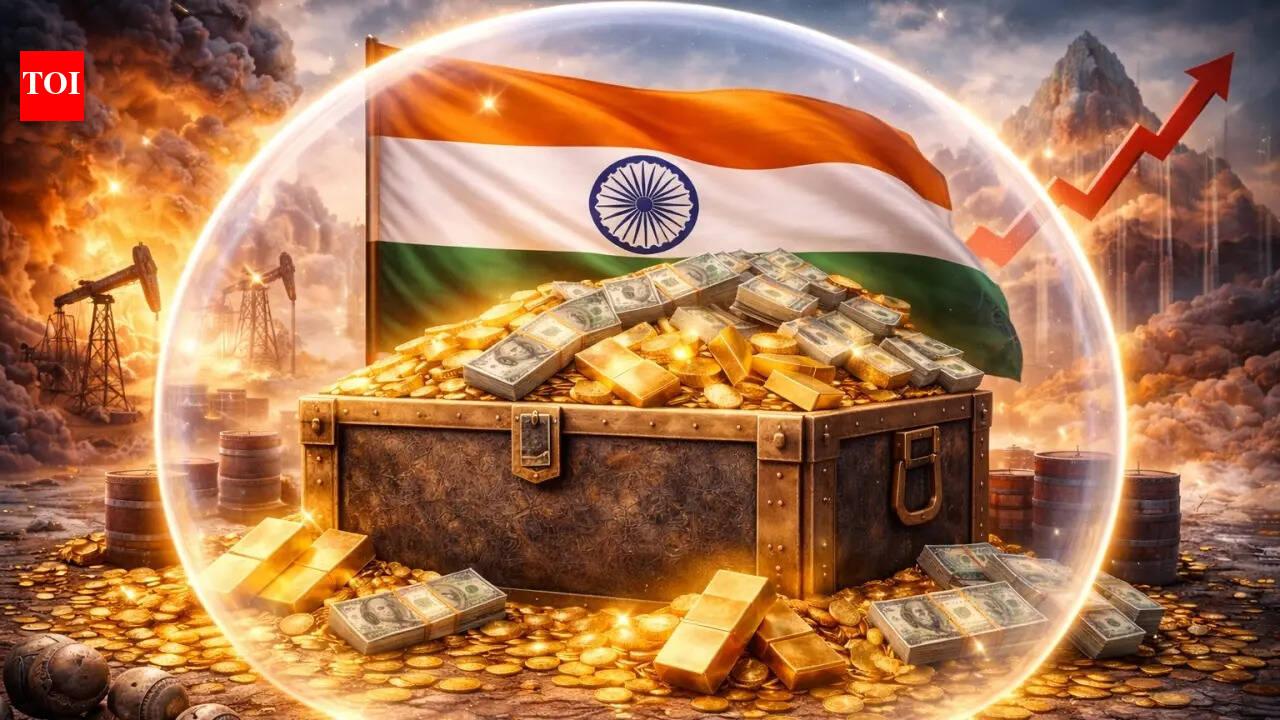
India’s forex reserves have become more balanced over time, with more gold and some diversification beyond the US dollar. (AI image)
A country’s foreign exchange reserves act as the first line of defence against external volatility. In times of global economic turmoil such as the present Middle East conflict, forex reserves are the armour that help shield against external risks.
Rising oil prices raise the import bill, hence bringing forex reserves in focus. Foreign exchange reserves’ position is a strong indicator to reflect the overall external situation of any country. This is why it is important and the import cover ratio reflects the strength of the same.
Foreign exchange reserves are essentially assets that a country’s central bank holds. These include foreign currencies, gold, and government securities.
They are mainly a financial buffer, helping maintain currency stability, and also helping meet external debt obligations. A decent forex cover translates into investor confidence.
Fundamentally, foreign exchange reserves tell us about a country’s ability to service its external debt. The more robust the cover, the better a country’s position of economic strength. Forex reserves can be used selectively by the RBI to sell currency in the market to bring a better match between demand and supply for dollars in the country.
So how strong is India placed in terms of foreign exchange reserves? According to World Gold Council data, at the end of third quarter of 2025, India had the world’s sixth highest forex reserves.
This year’s Economic Survey spoke of India’s robust forex cover. “India’s external sector is placed comfortably in the short run. Forex reserves cover over 11 months of imports as of 16 January 2026 and approximately 94.0 per cent of the external debt outstanding as of the end of September 2025, offering a comfortable liquidity cushion,” the Economic Survey said.
In fact, in a scenario of global economic uncertainty, the Economic Survey said that The country benefits from strong foreign exchange reserves.
But India’s forex situation has not always been strong, it has evolved over several decades.
India’s foreign exchange reserves: How the buffer has grown
In the decades following Independence, India's foreign exchange system was shaped by scarcity. The Reserve Bank of India operated within a tightly controlled regime where foreign currency was rationed, imports were prioritised, and the emphasis was on conservation rather than flexibility.
From about $305 billion in 2010-11 to nearly $700 billion in 2025-26, India's forex reserves have more than doubled in 15 years.
The expansion is even more striking over a longer horizon: reserves have grown nearly 75 times from around $9 billion in 1991-92.
In 1991-92, when reserves were down to just two weeks of import cover, The country faced a balance of payments crisis, forcing emergency measures including the pledging of gold.
The crisis triggered a policy reset. Liberalisation dismantled exchange controls partially, and redefined the RBI's role from allocator of scarce dollars to manager of external stability.
The real acceleration came in the early 2000s, when India began to attract sustained capital inflows. As foreign investment picked up and remittances strengthened, reserves moved from $42 billion in 2000-01 to $113 billion by 2003-04–nearly tripling within three years.
This approach deepened through the mid-2000s. With strong portfolio flows, reserves rose to $152 billion in 2005-06 and surged past $300 billion by 2007-08, effectively doubling again within a short span.
The 2008 global financial crisis tested the resilience of this framework. Capital flows reversed and reserves dipped to $252 billion in 2008-09, but the accumulated buffer allowed the RBI to stabilise markets without severe disruption.As global conditions improved, reserves recovered to $305 billion by 2010-11, completing a full recovery cycle.
A more complex challenge emerged during the 2013 taper tantrum, when expectations of US monetary tightening triggered capital outflows. India was labelled among the "Fragile Five" economies. With reserves at around $304 billion in 2013-14, the RBI responded with a coordinated set of measures: tightening liquidity, opening special swap windows, and incentivising foreign currency deposits through the FCNR-B scheme.
The episode marked a shift towards multi-layered intervention, where reserves worked alongside rather than instead of other policy tools.
The big expansion came during the Covid-19 pandemic - reserves jumped from $478 billion in 2019-20 to $577 billion in 2020-21, and further to $607 billion in 2021-22, an increase of over $125 billion in just two years. In the post-pandemic period, the strategy has shifted towards dynamic deployment.
From $578 billion in 2022-23, reserves rose to $646 billion in 2023-24, then $668 billion in 2024-25, and further close to $700 billion in 2025-26.
The February 2026 peak of $728.49 billion—since retreated partly due to RBI dollar sales to cushion the rupee against Middle East crisis-linked volatility–underlines that reserves are now actively managed in both directions.
Interestingly, the composition of reserves also reflects a focus on liquidity and resilience.
Foreign currency assets dominate, accounting for roughly 80% of the total at the end of FY26 ($552 billion), allowing the RBI to intervene quickly when needed. Gold holding at $115 billion in 2025-26, up sharply from $31 billion in 2019-20 provides diversification and a hedge against global uncertainties.
According to the Economic Survey, the growing share of gold in reserves aligns with a broader international pattern where many emerging markets have increased gold holdings amid geopolitical uncertainty and shifts in the global interest-rate cycle.
Madan Sabnavis, Chief Economist, Bank of Baroda elaborates on the importance of the mix - Reserves are three fold: currency, gold and SDRs. Currency is something which builds up based on the economic conditions. Gold has been procured gradually over time as part of a perceived diversification strategy which several central banks are doing. The strategy is to hold the right mix to address issues of volatility in currency as well as manage liquidity.
How secure is India’s forex position in the current scenario?
At nearly $700 billion, India's foreign exchange reserves are considered "sufficient" and "not a matter of concern," Reserve Bank of India Governor Sanjay Malhotra has said, even as the central bank continues to intervene in currency markets to manage volatility. The assurance reflects a position of relative strength that would have been difficult to imagine three decades ago.
India's reserves fulfill the condition of Guidotti-Greenspan Rule--a key IMF policy benchmark which proposes reserves should at minimum cover all short-term external debt (maturing within 12 months).
The Economic Survey sums up the situation simply: External buffers have strengthened, with foreign exchange reserves providing comfortable import cover and robust protection against external liabilities. The increase has come at a time when global interest-rate differentials, capital flows and commodity prices remain volatile. This expansion in reserves has helped steady India’s external position despite shifts in global risk sentiment and episodes of portfolio outflows.
The current account deficit is comfortably low. Foreign exchange reserves are ample. External remittances are strong.
Experts are also confident about India’s external sector, hailing the large forex reserves as an effective buffer in times of global uncertainty.
Madan Sabnavis points out that while there is no norm on ‘adequate’ levels of forex reserves, normally an import cover ratio of 4-6 months is considered to be prudent.
Today for us, it is in the 10-11 months range which signifies a good deal of comfort, he tells TOI.
According to Ranen Banerjee, Partner and Leader, Economic Advisory Services at PwC Bharat, India now has a very strong and comfortable forex position with close to $700 billion of reserves. This is equivalent to about 10 to 11 months of import bill cover that is a very comfortable position to be in, he says.
What forex reserves essentially do is that they give comfort to financial intermediaries on the ability of a sovereign to meet any shortfall on the current and capital accounts and this prevents speculative positions on the currency.
“The speculative tendencies are also curbed owing to the knowledge that the central bank can step into the trade with short term sale of forex to smoothen volatility in exchange rates,” Banerjee states.
As DK Srivastava, Chief Policy Advisor, EY India notes: RBI has a policy for minimizing exchange rate volatility. The availability of foreign exchange reserves provides it the flexibility to add to or withdraw from the supply of the US dollars when the rupee depreciates/appreciates unduly.
The larger the volume of such reserves, the larger is the capacity of the RBI to intervene.
Yet another important point to note is that the size of the forex reserves boosts investors’ confidence in the economy and its ability to finance its debt.
“Investor confidence and capital flows depend both on the size of the foreign exchange reserves and its composition. Any external investor would need to have confidence that he will be able to withdraw money when there is global uncertainty.
A larger volume of foreign exchange reserves gives confidence to external investors,” claims Srivastava.
“However, such reserves should be managed in a way that they also yield a tangible return rather than remain idle. An appropriate portion of foreign exchange reserves could be suitably invested abroad providing a combination of return and stability,” he adds.
India has also made it clear that no particular level of rupee will be targeted.
Hence, RBI selectively uses its forex reserves for intervention, banking on other measures to curb volatility. The rupee has depreciated in the last year, and the RBI has intervened to stem volatility, but has time and again made it clear that no particular level is targeted and it is only volatility that the central bank is aiming to keep in check.
The RBI's role has been to manage currency volatility– absorbing excess inflows during surges and supplying dollars during stress, ensuring stability in the exchange rate without committing to any fixed level of exchange rate versus the dollar.
“The RBI uses it (forex reserves) selectively and openly states that they have no view on the value of the rupee but would like to lower volatility in the trade. For this there is continuous monitoring of global markets and trends,” asserts Madan Sabnavis.
DK Srivastava also points out that the RBI does not intervene when depreciation of the rupee happens due to structural reasons. Any structural exchange rate depreciation or appreciation is allowed to happen.
“Only the volatility along the trend line determined by structural forces is minimized by RBI’s intervention. Under such circumstances, excessive or aggressive utilization of foreign exchange reserves is not called for,” he tells TOI.
Anshita Sachan, Assistant Professor, Fortune Institute of International Business notes that while the current forex reserves place Bharat comfortably, there are some signs of pressure.
India’s forex reserves have become more balanced over time, with more gold and some diversification beyond the US dollar, which helps in handling currency fluctuations. However, the main issue remains that The country depends heavily on imported crude oil, around 85 to 90 percent, and much of this supply comes through the Strait of Hormuz, making it risky during geopolitical tensions, Sachan notes.
“Right now, reserves of about $698 billion, covering nearly 11 to 12 months of imports, look comfortable.
But there are signs of pressure. Reserves fell by about 11.4 billion dollars in one week recently, while the rupee has weakened and foreign investors are pulling out. At the same time, oil prices have increased, transport costs have gone up three to four times, and shipping now takes longer, all of which increase India’s import bill.
Fertiliser prices have also risen sharply, with urea moving from below 500 dollars to above 700 dollars per metric ton,” she adds.
Talking about the worst case scenario, Sachan said that if tensions in the Hormuz region continue, oil prices could rise further, even crossing 150 dollars per barrel. “This would increase inflation, widen the trade deficit, and put more pressure on the rupee. So, while reserves are enough for now, they may not be sufficient if the situation continues for long. India needs to reduce its dependence on oil and move more trade into local currencies to stay more stable,” she notes.
Vivek Kumar, Economist at QuantEco Research says that in the case of India, it has been emphasized in the past that 6 months of merchandise import cover serves as the minimum comfort threshold for reserves (the IMF puts this at 3 months). However, it is wise for net importing economies to stay comfortably above the minimum threshold to ensure continued availability of additional moat, he believes.
“RBI has displayed comfort with a merchandise import cover of at least 9 months.
Having said that, with the high unpredictability of the geoeconomic and geopolitical environment in recent years, it would be in finest interest to raise the import cover to 12 months,” he tells TOI.
For March 2026, the implied value of comfortable forex reserves at 9 months is around $750 bn (it is estimated at $950 bn if one considers enhanced protection of 12 month cover). The central bank has been aggressively dipping into its war chest to smoothen rupee volatility.
“This works well if the global shock is temporary and of a generalized nature. However, if the external shock turns out to be of durable nature, then continued run down of reserves might not be an optimal policy choice. The central bank would need to balance medium-term fire fighting capability vs the need for adequate macro adjustment. A practical way out of this dilemma could be to activate unconventional measures to curb excess currency volatility via targeted temporary policy measures,” Vivek Kumar opines.
As reserves have grown, so has the policy debate. Large reserves provide insurance against external shocks and bolster investor confidence, but they also involve real costs: lower returns on safe assets, sterilisation challenges when dollar purchases inject excess rupee liquidity, and the risk that corporate borrowers leave foreign currency exposures unhedged.
It’s also important to note that while more is always better when it comes to forex reserves, there are also implicit economic costs of holding excess reserves.
As such one needs to weigh the cost-benefit of holding reserves, while striving for a certain degree of adequacy, notes Vivek Kumar.
As the Economic Survey notes: The nation has managed its external accounts prudently in the last decade. Foreign exchange reserves have risen, external debt remains manageable, and crisis episodes have been navigated without systemic collapse. These achievements reflect sound macroeconomic management.
Yet the survey asserts that the source of stability matters. Much of India’s external financing has come through portfolio flows, debt inflows, and episodic surges of foreign investment. “These flows are valuable, but they are conditional and reversible. They respond not only to domestic fundamentals, but to global liquidity cycles, risk sentiment, and geopolitical developments beyond India’s control. Currencies backed primarily by capital inflows behave differently under stress than currencies backed by persistent export surpluses.
In moments of global risk aversion, capital retrenches. Exchange rates adjust, sometimes abruptly. Central banks can help smooth volatility, but they cannot permanently offset structural imbalances through reserve accumulation or interest rate adjustments. This is the hard constraint confronting India’s macroeconomic aspirations, and India has already felt its impact this year,” the survey says.
In fact, RBI governor Sanjay Malhotra actually expects the balance of payments position to improve going forward, despite rising crude oil prices internationally.
"We do need to continue the good work that has been done on both the current account and on the capital account. And that makes me confident that the BOP position should improve going forward,” Malhotra said recently after RBI’s monetary policy earlier this week.
Going forward, Bharat will have to continue to focus on keeping its external resilience intact, with forex reserves continuing to act as an effective front line shield to global economic shocks.
Ready to Make a Smarter Property Decision? Build Your Legacy with TOI Homes
Is your honey pure? Simple ways to detect adulteration
Top 5 emerging real estate hotspots in India and why people are investing here
Why you should avoid certain types of sprouts and 3 common mistakes to avoid while consuming them
Divyanka Tripathi to Smriti Irani: TV queens who made us love sarees all over again
Temples in India with incredible backstories that will leave you amazed
24 hours in Delhi: 10 summer-friendly street foods to enjoy in the national capital
Cute first and middle names for kids born on Saturday
6 smart small balcony layouts that maximise space effortlessly
8 modern and not-so-common baby names for kids born on a Friday
US-Iran conflict: At nearly $700 billion, how India’s forex reserves are a strong armour against global crises
From queues to QR codes: How UPI transformed India’s digital payments, now driving 49% of global real-time transactions
'Open and welcoming to global capital': Sebi chair Tuhin Kanta hails India's finance landscape
100% road tax waiver for electric cars, new rules for 2, 3 and 4 wheelers - what Delhi govt's draft EV policy says
‘Great!’ Trump reacts as 'wave of empty tankers' head for American oil
Fuel for thought: The country boosts domestic LPG output to 60% amid Middle East tensions
$950 million bet before Trump's announcement? US senators urge probe into ‘unusual’ oil trading
India must be cautious about West Asia energy reliance: ONGC
Centre's fresh CAFE 3 brew seeks to ease life for car cos
Chandra asks Air The country staff to control costs, improve services
US-Israel-Iran War Ceasefire News Live Updates: Donald Trump speaks to Netanyahu, asks Israel to pull back on Lebanon strikes
Gold, Silver Rate Today Live Updates: Gold prices rise in international markets; where are the headed in near-term?
TGBIE TS Inter Result 2026 Date & TIme Live Updates: TSBIE to announce 1st, 2nd year results soon for over 9 lakh students
4.5 magnitude earthquake jolts Maharashtra's Hingoli; no casualties
TSBIE Results: TS Inter 1st and 2nd year scores on April 12 at tgbie.cgg.gov.in; check detials here
Bumrah or Hazlewood, doesn't matter: Vaibhav Sooryavanshi says 'play the ball, not bowler'
Drama in PSL over Usman Tariq's action: Batter walks away twice vs Pakistan spinner - Watch
PCB, PSL under fire after ex-Pakistan captain Misbah ul Haq's role comes to light
IPL 2026: Vaibhav Sooryavanshi blitz scripts history, powers Rajasthan Royals to...
Kash Patel to head CIA, Vivek Ramaswamy homeland security? What a Trump 2.0 Cabinet may look like
Determine the monthly installment amount for a loan
Estimate the returns on investments made through SIPs
Find out maturity amount and interest earned on PPF
Estimate the pension amount and corpus accumulated under NPS
A Mutual Fund Calculator helps estimate the future value of investments
Talks As Cover? US Moves Elite Troops For Deployment In Middle East | Watch
Ishq Traffic - Official Teaser
Nitish Kumar’s Rajya Sabha Oath Triggers Bihar Leadership Buzz: Who Will Be the Next CM?
PM Modi Targets TMC Syndicate Raj In Bengal, Vows White Paper And Probe Into Corruption Cases
Watch: Unmissable Moments From NASA’s Artemis II Mission
Trion Teaser : Rebecka Harper and August Wittgenstein Starrer Trion Official Teaser
ON CAM: Pak F-16s Escort Air Force Two As Vance Lands In Islamabad For Iran Nuclear Talks
‘IF YOU CHEAT THIS TIME...': Iran Issues First Blistering Warning To US From Pakistan | WATCH
Iran Signals First Win In US Talks, Asserts ‘Pre-Conditions Accepted’ | Watch
'DEADLY STRIKE BEFORE TALKS': Arab Fighters Shock Israel With Big Attack, Key IDF Site 'DEVASTATED'
US–Iran Negotiations In Islamabad Face 'Delay' As Key Differences Persist | Watch
"Behen Darr Gayi!": Fans relive ‘Bhagam Bhag’ era after watching Akshay Kumar's 'Bhooth Bangla' trailer
MBOSE HSLC result 2026 to release tomorrow: Check details here
Iran war risk: JPMorgan CEO Jamie Dimon warns of oil shocks, sticky inflation and higher interest rates
Make your clutch last longer with these easy driving tips
“Three-against-one situation”: El Rubius opens up on being “targeted” in MrBeast’s viral $1M challenge
Bihar BTSC lab assistant notification released for 1091 posts at btsc.bihar.gov.in; apply here
IPL craze costs techie Rs 1.46 lakh in fake RCB vs CSK ticket scam
Raising “robot-proof” kids: Why creativity and curiosity matter more than ever
Inside ‘Satguru Sharan’: Exploring Saif Ali Khan and Kareena Kapoor Khan’s Rs 100 crore Bandra home
How selling Alaska in 1867 was a costly mistake for Russia
'Hera Pheri 3 is coming': Paresh Rawal dismisses delay reports and reveals he will 'start shooting soon'
US-Iran War: A daring rescue Hollywood blockbuster is on its way. Till then, pick your favourite from these 10 films on bringing someone home against all odds
Kolkata team unveils fan mural at Rash Behari Avenue, celebrating city’s first love
How US spread a lie to rescue a pilot of a jet shot down in Iran
Netflix unveils ‘VOID’, an AI model that can change a movie plot
AI data centers are causing 'stress' not just to tech companies, but also private insurers
"Trans women are.....": Clavicular’s viral moment with trans women sparks fresh conversation on internet culture
Copyright © 2026 Bennett, Coleman & Co. Ltd. All rights reserved. For reprint rights: Times Syndication Service
.png)
